WHO Academy
Building a 1,454‑Person Enrolment Waitlist in 6 Days
I was asked to build a global course waitlist, fast, with no budget and no ads. I built a referral system that turned my colleagues, none of them marketers, into an acquisition engine.
In six days, the referral system generated 1,454 leads across seven languages, at zero cost.

Case study 05
My role
Growth & Operations Lead
Client
WHO Academy, an EdTech startup built inside the World Health Organization.
Industry
Healthcare · EdTech · Education
Skills demonstrated
Build a globally targeted course waitlist, to this brief:
The constraint
No budget, no ads team, no time. The only resource I had was people, my own team and their networks, and none of them were marketers.
With no budget, the highest-leverage lever wasn't advertising, it was turning the people we already had into referrers. My job was to make sharing easy.
{{ activeTitle }}
{{ para }}
01
Embedded tracking pixels for the future.
Every link carried multiple embedded tracking pixels. We didn't have our own social channels or ad accounts at the time, but I built the campaign so that if we ever did, we'd already have the audience data to draw on, custom audiences we could rebuild from those pixels to power targeted advertising downstream.
02
Every link was trackable, so we could quantify the campaign's results.
Every referrer's links were numbered and attributed, so I could quantify exactly who brought in the most leads and which channels responded best, dentistry networks, student groups, regional associations, all measured. Before we'd spent a penny or run a single real campaign, I knew where our most engaged audiences lived and who our strongest internal advocates were.
Shared post
One of 28 links, each attributed to a person and a channel.
Link tracker
{{ trackTotal }}
The system was simple and built for speed.
- {{ s.num }} {{ s.text }}
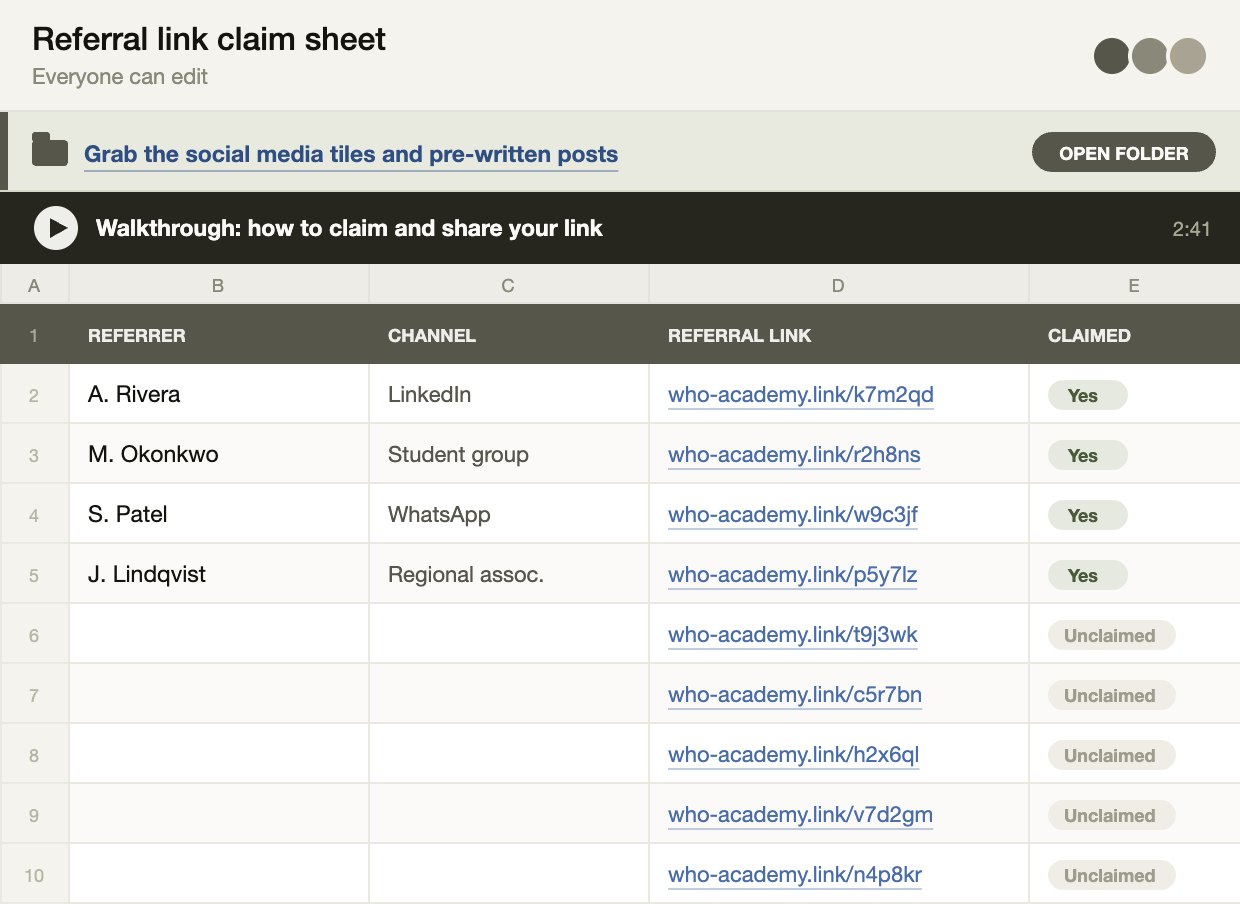
In six days, we didn't just build a waitlist, we acquired a segmented, permission-based pool of future testers and future learners, months before launch.
Every sign-up completed an in-depth qualification survey: which courses they wanted to review, which languages they'd test in, where they were based, and explicit permission to be contacted for testing.
Twelve people brought in an average of 121 leads each. The result came from the way the campaign was built: knowing the organisation's fastest growth lever, educating the team so we could use it, equipping them so it was easy and measuring everything so we had better data next time.
I had the pleasure of working with Dayle at the World Health Organization Academy during its set-up and start-up phases. Dayle led the development of the Academy's growth and digital marketing strategy, applying the latest in data-driven and design thinking approaches towards supporting the Academy to achieve the goal of reaching 10 million digital learners. Digital marketing and growth was new to the WHO at the time and Dayle has been instrumental in leading the team's capacity and broader WHO thinking in this area.
Former Project Lead, World Health Organization Academy
Next case study
Getting them signed up was half the job. Next: getting them testing.
The Operational Engine Behind User Testing in 7 Languages
Having built the waitlist, I had to turn 1,454 sign-ups into active testers. That meant onboarding people worldwide, asynchronously, across seven languages and every device. I built the system that made it work: the onboarding flow, the email sequence and the guided instructions to navigate the testing infrastructure, end to end.